.png?width=542&height=179&name=PNG-Averitt%2055%20Years%20RED%20ODFIP%20(1).png)


As we move into 2026, the warehousing market is showing early signs of moderation—but not normalization. While select markets are beginning to soften, warehouse costs nationally remain elevated compared to pre-2020 levels, and pricing behavior continues to vary widely by geography.
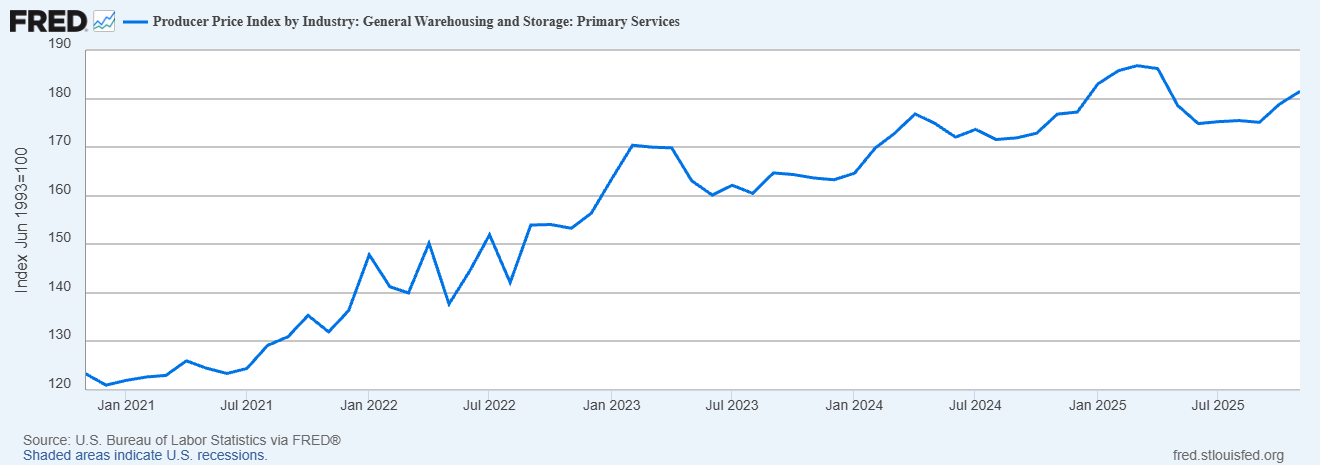 Source: Federal Reserve Bank of St. Louis
The headline number is not the story. What matters is the growing divergence in pricing pressure across the network. Port-adjacent locations, rail-served hubs, and inland markets are moving on materially different paths, driven by structural constraints around land, zoning, labor, and import flows. This divergence is forcing a reassessment of where inventory is positioned and how distribution networks are designed to protect cost, service, and resiliency.
In this environment, the traditional approach of optimizing for the lowest warehousing services rate is becoming less effective. Flexibility and inventory velocity are emerging as more durable advantages than static cost savings.
Ports Are Becoming Flow Points, Not Storage Points
One of the clearest shifts we’re seeing is around port-adjacent warehousing. Even when national warehouse pricing eases, space near ports remains structurally constrained. Limited land, sustained import activity, and regulatory barriers are creating persistent cost premiums that are unlikely to disappear with a single market cycle.
As a result, many organizations are reevaluating the role of the port in their network. Instead of asking how long inventory can sit near the port, the more strategic question is how efficiently it can move through it.
Reducing dwell time—whether through transloading, inland repositioning, or alternative routing—has become one of the most effective ways to offset elevated warehouse costs while improving service reliability. Inventory that flows keeps working capital productive; inventory that stalls compounds risk.
Velocity Is the New Buffer Against Volatility
Trade policy shifts, tariffs, and evolving port dynamics continue to introduce uncertainty into global supply chains. In response, many companies are moving away from rigid, long-term facility commitments in favor of networks that can scale, rebalance, and adapt as conditions change.
We saw this play out recently when tariff pauses and demand swings prompted surges in inbound inventory. Companies with flexible distribution options were able to absorb volume, reposition inventory across multiple facilities, and maintain visibility—without overcommitting to space that might not be needed long term. When conditions stabilized, inventory moved back into established networks with minimal disruption.
These scenarios highlight a broader reality: resilience increasingly comes from optionality. Networks designed for movement—not permanence—are better positioned to absorb the next disruption, whatever form it takes.
Designing Networks for Multiple Futures
The most effective supply chains in 2026 will not be built around a single forecast. They will be designed to perform across multiple scenarios and supply chain disruptions—rising costs, shifting trade lanes, port congestion, or sudden demand changes.
That requires rethinking your supply chain strategy and network design through a broader lens:
- How quickly can inventory be repositioned?
- Where does flexibility reduce risk more than it increases cost?
- How can ports function as accelerators rather than bottlenecks?
Often, small adjustments in transload strategy, inland routing, or inventory placement can meaningfully reduce exposure while improving speed to market.
The Takeaway
In today’s environment, competitive advantage is less about where inventory sits—and more about how fluidly it can move.
Companies that treat ports as flow points, design for flexibility, and prioritize velocity alongside cost will be better equipped to navigate uncertainty and capture opportunity in the year ahead. Network decisions made today will shape how well organizations absorb the next wave of change—before it arrives.
Averitt Distribution & Fulfillment
Averitt Distribution & Fulfillment provides asset-based warehousing, transloading, and distribution solutions designed to help companies move inventory more efficiently through their supply chains. Integrated with Averitt’s transportation network, shippers can benefit from flexible inventory placement, improved visibility, and faster velocity to market—without locking customers into rigid space or long-term commitments. By managing warehousing, port and and inland transportation together, our team helps organizations reduce risk, control dwell time, and adapt their distribution networks as market conditions change.
Watch the video below to learn more!

Looking for more insights or to start a one-on-one discussion? Connect with David Gniewek, Director of Port and Distribution Sales, on LinkedIn.
Design a more flexible distribution network
Considering optimizing your warehousing and port strategy? Start a conversation with our team to evaluate your port, warehousing, and inventory flow strategy by filling out the form below or sending an email to distribution@averitt.com.