.png?width=542&height=179&name=PNG-Averitt%2055%20Years%20RED%20ODFIP%20(1).png)


St. Louis has always been a city defined by movement.
Long before interstates and intermodal networks, its position along the Mississippi River made it one of America’s most important commercial crossroads. As the historic “Gateway to the West,” St. Louis helped connect eastern industry with western expansion, building a legacy rooted in transportation, trade, and access.
Today, that same strategic geography continues to make the region one of the country’s most valuable logistics hubs.
And for Averitt, St. Louis represents far more than a point on the map – it’s a critical inland gateway for moving freight efficiently across regions, modes, and markets.
A Market Built on Connectivity
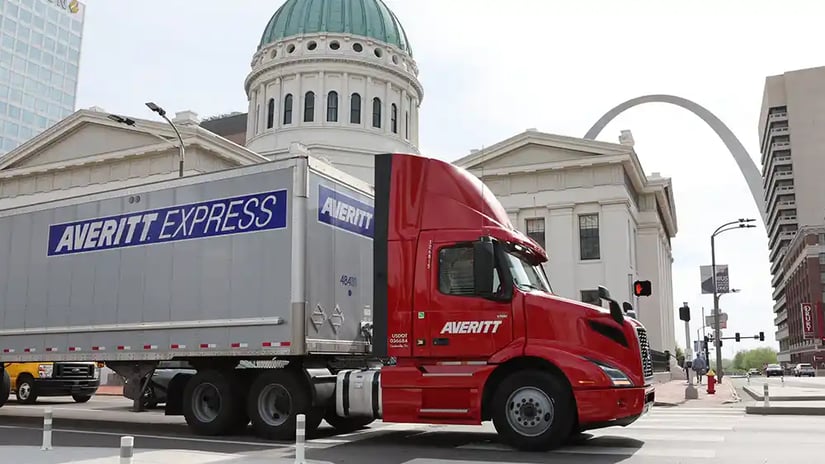
Few markets offer the kind of reach that St. Louis does. Positioned near the center of the country, the region connects major north-south and east-west freight corridors, making it ideal for freight flowing between the South, Midwest, Great Lakes, Northeast, and key cross-border points. Its strong interstate access, concentration of major rail providers, and proximity to multiple rail yards make it especially well-suited for intermodal service and pool distribution strategies.
That combination of geography and infrastructure creates powerful opportunities for businesses looking to optimize inland freight movement, reduce costs, and create more flexible delivery paths.
Which is why St. Louis continues to be one of the most strategically important freight crossroads in North America.
Thirty Years of Strategic Presence in St. Louis
This year marks 30 years of Averitt’s presence in the St. Louis market – reflecting three decades of helping customers connect freight beyond the traditional edges of our footprint.
Located in Bridgeton on the northwest side of the metro area, our St. Louis Service Center plays a unique role within the network. From this position, freight can move efficiently into our southern network while also supporting partnership connections throughout the Midwest, Southern Illinois, and into Canada.
That geographic advantage creates unique opportunities for customers looking to extend reach without adding complexity.
Freight can move through St. Louis as a central handoff point for broader regional distribution, allowing customers to reach markets beyond our standard direct lanes, while maintaining the visibility and service standards they expect from Averitt.
A Powerful Inland Gateway for Pool Distribution
One of the most exciting opportunities in St. Louis is pool distribution. As supply chains look for smarter ways to consolidate freight and improve regional density, St. Louis offers an ideal inland gateway for bringing volume into Averitt’s footprint and distributing it efficiently across downstream markets.
That opportunity is especially valuable in outlying markets, where customers can route larger-volume freight through St. Louis before final delivery into the South and surrounding markets.
This approach helps improve efficiency, create stronger lane economics, and support scalable growth across regional customer networks.

NEXT-DAY REACH THAT SETS ST. LOUIS APART
St. Louis doesn't just connect freight corridors — it accelerates them.
From our St. Louis Service Center, Averitt provides standard next-day service to some of the most important freight markets in the country, including Chicago, Milwaukee, Louisville, Nashville, Memphis, and Atlanta. These are high-demand lanes where speed matters, and our St. Louis presence delivers it consistently.
But the standout lane is Dallas.
Standard next-day service between St. Louis and Dallas is rare. Very few carriers offer it at all, and Averitt does. For shippers moving time-sensitive freight between these two major commercial markets, that's a meaningful advantage that's hard to find elsewhere in the market.
Whether you're moving product into the South, up through the Midwest, or across to key distribution points in the Southeast, St. Louis puts your freight in position to arrive fast without the premium typically associated with expedited options.
See exactly where your freight can go and how fast with Averitt's St. Louis LTL transit map or get door-to-door timing with our transit time calculator.
Intermodal Strength That Expands Reach
St. Louis is also uniquely positioned to support Averitt’s intermodal capabilities.
With access to COFC and EMP container opportunities, customers can leverage competitive one-way container movements, stronger dray control, and more flexible drop or live-load solutions across targeted lanes.
That flexibility is especially valuable in lanes moving into the Northeast, Florida, and key domestic distribution points, where rail can create meaningful cost and service advantages over traditional over-the-road options.
Combined with strong drayage partnerships and local rail access, St. Louis becomes more than a Service Center – it becomes a strategic inland conversion point between rail, road, and final-mile delivery.
Want a deeper look at how intermodal works and where it fits? Averitt's Allison Phillips breaks down real transit times, cost savings, and the best lanes for rail in this episode of Beyond Point to Point.
Positioned for the Next Era of Freight
As rail networks evolve, intermodal opportunities expand, and businesses look for smarter inland distribution strategies, St. Louis is positioned to play an even greater role in the future of freight.
For Averitt, our long-standing presence in the market, combined with growing pool distribution and intermodal capabilities, allows us to help customers unlock smarter ways to move freight across domestic and cross-border lanes alike.
From its roots as America’s original gateway to its role as a modern inland logistics hub, St. Louis continues to prove that the right location can create the right opportunities.